In this issue
 |
 |
ECOS
Issue 116
|
| |
|
|
Gore gives a wake-up call for leadership
A new reality now dominates the relationship between civilisation and the Earth itself, Al Gore has told an audience of Australia's most senior corporate leaders. Whereas past generations could comfortably say that the planet was so large and humans so small that what we did hardly mattered - that was not the case any longer.
Download Article
|
|
| |
|
Government and business agree on an action plan
At a trans-Tasman summit held on 13 June 2003 in Brisbane, Australian Environment Ministers and company CEOs acknowledged that a bolder, more urgent pursuit of sustainability initiatives is essential to underpin Australia's future growth, prosperity and quality of life.
Download Article
|
|
| |
|
Perth's hydrogen bus trial
By the middle of 2004, three prototype hydrogen-powered buses will begin operations in Perth, WA. Each will have nine hydrogen tanks and two fuel-cell stacks on the roof to convert the energy in hydrogen to electrical energy to run the bus motor.
Download Article
|
|
| |
|
Bluefin social study
A detailed social and political profile of the fragile southern bluefin tuna fishing industry is being developed to reduce potential for quota tensions between Japan and Australia.
Download Article
|
|
| |
|
Climate and ocean research boosted
Australia's contribution to the quest for understanding of regional climate and ecosystem influences was strengthened on 31 July 2003 with the launch of the Cooperative Research Centre (CRC) for Antarctic Climate and Ecosystems in Hobart, Tas.
Download Article
|
|
| |
|
A forward look at city sprawl
Acknowledging the pressing challenge of sustainability in our urban areas, the Federal Minister for Environment and Heritage has commissioned the Sustainable Cities 2025 Inquiry.
Download Article
|
|
| |
|
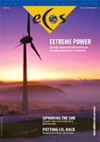
Extreme power
After a ten year planning phase, specially adapted wind turbines are now exceeding expectations at Mawson Station, Antarctica, showing the way ahead for wind power engineering in the most severe conditions.
Download Article
|
|
| |
|
Siphoning the sun
The solar tower project stands out as an innovative Australian commitment to finding alternative energy solutions. The facility, to be built near Buronga, NSW, could power 200,000 homes from the world's tallest man-made structure.
Download Article
|
|
| |
|
New efficiency from our old systems
Whole systems engineering is providing innovative and exciting ways of looking at the overall design and efficiencies of established industry systems. It can uncover significant, hidden, long-term value that provides a strong argument for taking on the often daunting upfront costs associated with change.
Download Article
|
|
| |
|
A platform for change
The Natural Edge Project argues that, with better integration across society, today's key drivers of unsustainable practice in Australia could be re-harnessed as the engines of real progress. It brings together the basis for national natural competitive advantage based around the whole-of-society approach.
Download Article
|
|
| |
|
Australia after rabbits
Since its escape from Wardang Island, SA, in 1995 rabbit haemorrhagic disease (RHD) has caused massive mortalities in Australia's rabbit populations. The crash in rabbit numbers is giving cause for cautious optimism as pastoralists and researchers record the impact on native flora and fauna and on agriculture, and work to keep the populations pinned down.
Download Article
|
|
| |
|
Seeds of life cast a golden hue
With the independence struggle over, East Timor is trying to establish its basic agricultural and economic needs. Brian Palmer's experience is helping sow the seeds of self-sufficiency in the world's newest nation.
Download Article
|
|
| |
|
Putting CO2 back
Underground sequestration could be a long-term, high-volume greenhouse gas solution. Scientists of the GEODISC program at the Australian Petroleum Cooperative Research Centre (CRC) are conducting research into all aspects of geological storage of carbon dioxide.
Download Article
|
|
| |
|
There's money in the air
Regardless of the short-term future of the Kyoto Protocol, it would seem that the lucrative trading of greenhouse gases is a burgeoning new industry staking the future on emissions legislation, and predicting change.
Download Article
|
|
| |
|
Taking Natural Capitalism to the world
The 1999 publication 'Natural Capitalism' details a new model that enables companies to realise the opportunities sustainability brings. Co-author, Hunter Lovins, is now focusing on implementing the principles of 'Natural Capitalism' throughout the business world.
Download Article
|
|
| |
|
Beefing up the locals
Australian genetics know-how is helping South Africans to have heavier beef, healthier land and a happier life. The Beef Profits Partnerships Project is looking at the genetic potential of several African cattle breeds.
Download Article
|
|
| |
|
Worm eater shows green promise
Duddingtonia flagrans, a nematode worm-eating fungus, reduces the number of nematode larvae in young sheep. The promising biological control agent could help fulfil an increasing demand for agricultural commodities free from chemical inputs.
Download Article
|
|
| |
|
Fish need healthy stream banks
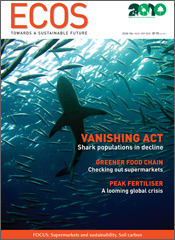
The riparian zones of rivers and streams are usually high in biodiversity. Fish communities suffer when riparian vegetation is destroyed and recover only when riparian integrity is re-established.
Download Article
|
|
| |
|
What's wood worth?
To accurately calculate carbon dioxide emissions from land-use change and forest management, scientists must understand the decomposition rates of coarse woody debris (CWD) on forest floors. To gain a better understanding of wood decomposition, scientists have reviewed the patterns and rates of decomposition of CWD.

Download Article
|
|
| |
|
| |
|
|