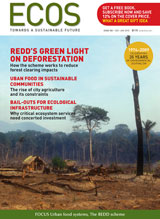
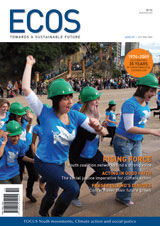
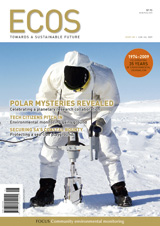
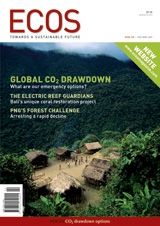
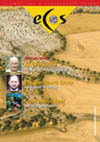
In this issue
 |
 |
ECOS
Issue 54
|
| |
|
|
Alien dune plants reshape our beaches
European immigration has greatly changed the face of Australia. To give added dimension to that change, several introduced plants, some through their own tenacity, others through use by well-meaning foreshore managers in stabilising coastal dunes, have proliferated and are altering the appearance of our coastline.
Download Article
|
|
| |
|
Of mice and men - and nematodes
Although cute enough to be kept as pets and immortalised in cartoons, mice can be a serious problem, frequently attaining the status of a destructive pest in many parts of the world. At certain times in rural Australia (especially the cereal-growing belt in the eastern and southern parts of the country), numbers of house mice (Mus domesticus) increase to plague proportions. The results are often serious. A parasitic nematode, called Capillaria hepatica is being considered as a biological control agent.
Download Article
|
|
| |
|
Electromagnetic probe for hidden salt
In much the same way as environments differ acoustically, they also do electromagnetically, and a radio receiver will pick up different signals according to the electromagnetic ambience in which a nearby transmitter is operating. For many years geophysicists have been making use of this characteristic to prospect for minerals. Salinisation of land has become a major problem over large sections of Australia. Electromagnetic equipment is being used to detect the advance of this hidden menace.
Download Article
|
|
| |
|
Termites and nutrient cycles in the north
One of the basic principles of ecology, and one upon which all life on earth depends, is recycling. Many of the elements important to living things move from an inorganic form in the rocks, atmosphere, or ocean to a form that is incorporated inside an organism - and then back again when waste products and dead organisms decompose.
Download Article
|
|
| |
|
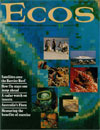
Fire risk rating by satellite
As summer's withering sun turns the paddocks brown, Victorian Country Fire Authority staff will be using polar-orbiting satellites to rapidly inform them how dry the State's grasslands have become.
Download Article
|
|
| |
|
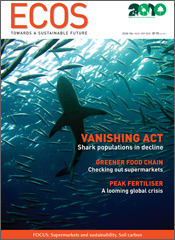
Trees and fungi: a productive partnership
During the season of mists and mellow fruitfulness the sight of mushrooms sprouting at the base of a tall forest tree is not uncommon. It may seem that a large tree need have little regard for those fungi that, apparently coincidentally, live at its base. But, in fact, the attentions of a mould can signal extra life or untimely death for many trees.
Download Article
|
|
| |
|
New factory not a recipe for smog
The construction of an $85 million float-glass plant in Sydney will go ahead, after CSIRO research indicated that nitrogen oxides released by the plant, 1,200 tonnes a year, would not add to the city's photochemical smog problem.
Download Article
|
|
| |
|
Better scouring, cleaner effluent
If you've ever had to wash a heavily soiled wool jumper, you can appreciate the task facing our scouring mills. Their job is to turn the shorn fleece, laden with grease and dirt, into clean white fibre. The CSIRO has now come to the aid of financially burdened scouring mills. After years of research into the physical and chemical mechanisms of the scouring process, the Division of Textile Industry has licensed a chemical engineering firm to market SIROSCOUR, a much more efficient method.

Download Article
|
|
| |
|
Tracking insects in the bush
It is often been pointed out that the thinly populated remote north of our country, offers scope for an invasion that would be hard to detect. This observation is particularly apt in the case of insects. However, now a new weapon will at least help us to track the march of the midges. It is a solar-powered insect collector.
Download Article
|
|
| |
|
| |
|
|