In this issue
 |
 |
ECOS
Issue 128
|
| |
|
|
Coopers' yeast sent to Suntory in good taste
Adelaide's Coppers Brewery has an agreement and a new export opportunity with Japanese distilling company Suntory under which live waste yeast from their brewing process will now be used to improve the flavour and complexity of Japan's favourite whisky.
Download Article
|
|
| |
|
A sweet European deal for Plantic's bioplastic
Innovative Melbourne-based packaging company Plantic Technologies has won its first major customer in the European market, after signing a contract with Nestlé in the UK for the use of its bioplastic in the food giant's Dairy Box chocolate range.


Download Article
|
|
| |
|
Success with Polish coal bed CO2 sequestration
An international research project involving Australian expertise has successfully stored carbon dioxide (CO2) in European coal beds, raising further promise that geological sequestration can be a viable strategy to help reduce greenhouse emissions from coal burning in Australia.
Download Article
|
|
| |
|
The first cuts must be the deepest
A number of emerging international studies are showing that the deep cuts in greenhouse gas emissions needed to stave off severe global warming effects can actually be achieved, economically, by 2050.
Download Article
|
|
| |
|
Inside Asia's Rice Revolution
An innovative rice-growing technique, known as the 'System of Rice Intensification'(SRI), is being steadily taken up by farmers across Asia because of its claims to significantly reduce water use, produce higher yields and endow farms with associated environmental benefits. But differing perceptions of the management, risk and verification of the technique are at the core of a widening international argument over whether SRI really has the radical advantages over the traditional flooded-field style of rice cultivation.
Download Article
|
|
| |
|
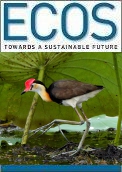
A new wetlands effort for the last Southern Brolgas
Numbers of the majestic Southern Brolga have declined dramatically since European settlement, but restoration of a wetland in northern Victoria, a combined effort by the Loddonvale Landcare Group, the Norman Wettenhall Foundation and the North Central Catchment Management Authority (NCCMA), is improving its local prospects.
Download Article
|
|
| |
|
Private conservations
Land trusts, also known as heritage, private or statutory conservation trusts, have led the recent growth of conservation on privately held land. They seem to be well organised, well informed and financially viable and now, collectively, hold stewardship over hundreds of thousands of hectares of land, chosen for its high conservation value. How do these trusts work, what have they achieved, and where are they headed?
Download Article
|
|
| |
|
Our Swedish ways
With its archipelago lake system lapping at the shores of red-patched villages, Sweden's urban landscape doesn't really look much like Australia's. But that hasn't stopped Swedish and Australian representatives sharing a 'Partnership for Sustainable Cities'. Touring Australian cities earlier this year, the concept's creator, architect Ulf Ranhagen, of Lulea University, Lulea, joked that since the partnership began in the late 1990s, Australian cities have been turning a bit Swedish green around the edges.
Download Article
|
|
| |
|
Sound treatment for polluted sites
Australian researchers have discovered that pesticides and other undesirable pollutants in soil can be rapidly destroyed by exposing them to ultrasound. They hope their work will mean that soil from chemically contaminated sites can be cleaned and rehabilitated byuse of powerful ultrasonic waves in purpose-built treatment plants.
Download Article
|
|
| |
|
Rear-guard action for the innocent grey nurse
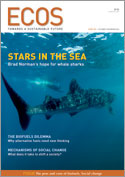
Grey nurse sharks have been killed in their thousands over the past two centuries. Originally hunted for their liver oil and later mistakenly blamed for shark attacks at Sydney beaches, fewer than 500 now remain on the east coast of Australia. With numbers continuing to decline by an estimated 18 sharks per year, these critically endangered and slow-breeding animals face local extinction. Researchers at the Macquarie University have joined an escalating race to help save them.
Download Article
|
|
| |
|
| |
|
|