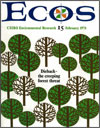
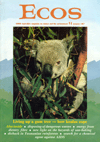
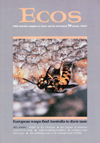
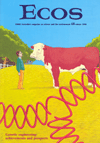
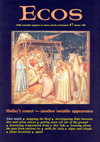
In this issue


Issue 15


Contents

PDF file Download Article
 

A destructive forest fungus
Walking through a eucalypt forest, you expect to see the odd dead or sick-looking tree. But if you come upon a patch where most of the trees and understorey plants are dead or dying, you can be fairly sure that something is amiss.
PDF file Download Article


More trouble for gum trees
Forests are home for many types of fungus, but undoubtedly the most familiar are the ones that produce mushroom-like fruiting bodies. Among these are species of Armillaria, which in some of Australia's moister eucalypt forests play an important role in breaking down dead plant material and returning it to the soil.
PDF file Download Article


New deserts; by courtesy of Man
Press and television pictures of famine-afflicted people have become all too familiar. In 1974 it was the turn of the Ethiopians. But just then they were only one of a number of the peoples living close to the fringes of the Sahara desert who were in a similar predicament.
PDF file Download Article


Bushfire smoke and city smogs
What will happen if smoke from a bushfire drifts into a city smog? Will it make the smog worse?
PDF file Download Article


Using whey’s polluting power
Disposing of whey — the liquid remaining after removal of butterfat and casein from milk — is a headache for the dairy products industry. Australian cheese and casein factories produce about 1600 million litres of the stuff each year, but there's little use for it other than as a pig feed.
PDF file Download Article


Discovering soils
You find soil science hard to understand? Do its fearful terms confuse you — try podzols and solonization — and do montmorillonitic minerals leave you cold?
PDF file Download Article


On the trail of bushfire smoke
Where does bushfire smoke go after it has drifted away from a fire? In ECOS 9 we reviewed the work of the Bushfire Section of the former CSIRO Division of Applied Chemistry. This group of scientists had been looking into the chemical composition of the smoke, tracking where it went, and seeing how it behaved.

PDF file Download Article


Making a residue pay
The Electrolytic Refining and Smelting Company is located at Port Kembla, N.S.W. During its copper-smelting operations, metallic impurities in the copper ore pass as fumes, along with sulphur dioxide gas, up the flue. At present, the 5000 tonnes of these impurities that each year are caught in bags are mixed with water to make a slurry and then stockpiled in ponds, where they have become something of a nuisance.
PDF file Download Article


Trial run for the Australian ecological survey
Recently, an ‘extinct‘ wattle was re-discovered in the Flinders Ranges of South Australia. Not long ago, also, a colony of tammar wallabies turned up in bush near Cleve on the Eyre Peninsula — a lost relic of this marsupial that was once common on the South Australian mainland.
PDF file Download Article


Bowing on the bough
Anybody who has walked through our cities knows that Australia has a lot of pigeons. The grey birds of the city, enjoyed by people who sit in parks and detested by cleaners of the outsides of buildings, came to Australia with European colonizers.
PDF file Download Article


Past Issues


2013

April 2013
March 2013
February 2013
January 2013

2012

December 2012
November 2012
October 2012
September 2012
August 2012
July 2012
June 2012
May 2012
April 2012
March 2012
February 2012
January 2012


Past Years

2010 to 2011
2000 to 2009
1990 to 1999
1980 to 1989
1974 to 1979


Feature Product

Australian Bird Names

Australian Bird Names

An up-to-date, readily digestible check-list of Australian birds and the meanings behind their common and scientific names.

RSS
WIN A BOOK monthly by subscribing to our email Contents Alert. Or register for RSS feeds.