In this issue
 |
 |
Issue 3
|
| |
|
|
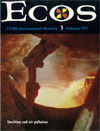
Cutting down on sulphur dioxide
Sulphur dioxide is a traditional air pollutant, not a Johnny-come-lately like the photochemical pollutants that the motor car has brought to cities. Ever since people started burning coal and smelting ores to make bronze, they have been putting it into the air.
Download Article
|
|
| |
|
Oil dispersants tested
Few things are as devastating to seashore environments as large oil slicks washed ashore. The oil clings to plants, sand, and rocks, and can kill fish, birds, insects, and vegetation. If detergents are used to remove it, these can cause even more damage to living things. The effects of alternatives — bulldozing, steam-cleaning, and burning — can be just as drastic.
Download Article
|
|
| |
|
Re-using sewage water
Each day some 2000 million litres of water flow out of Australia's sewers into the sea. Each litre has been used only once since it left the storage reservoirs in the hills. If this water could be purified and used again, it could reduce our demands on natural water sources quite considerably. The question is, can we make the sewage water clean enough to allow re-use?
Download Article
|
|
| |
|
Predicting climate change
Is the world entering a period of major long-term climatic change? Devastating droughts in Africa and Asia, increases in the Arctic ice cover, and other events (including the recent floods in Australia) have sparked off a stream of prophecies. Some people have predicted another Ice Age.
Download Article
|
|
| |
|
Energy and food supply
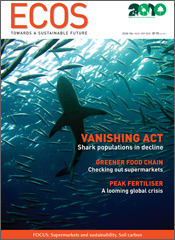
With future supplies of cheap energy anything but assured, finding ways to reduce the amounts we need is becoming increasingly important. Two CSIRO scientists in Canberra, Dr Roger Gifford of the Division of Plant Industry and Dr Dick Millington of the Division of Land Use Research, recently examined energy use in food production and distribution and looked at some possible ways to cut it back.

Download Article

|
|
| |
|
Toxic metals by the roadside
As well as putting unpleasant gases such as carbon monoxide and nitrogen oxides into the air, cars and other motor vehicles leave in their wake small amounts of the toxic metals lead and cadmium. The metals can accumulate in roadside soil and are taken up by plants growing there. If these plants are crops or pastures, the possibility arises that people or stock could be poisoned. Dr John David and Dr Colin Williams, of the CSIRO Division of Plant Industry, recently examined soil and plants from beside one of Australia's busiest highways and assessed the risk.
Download Article
|
|
| |
|
Understanding the East Australian Current
Right from the earliest days of European settlement, captains of ships sailing along Australia's eastern coast have known of a southerly 'set' that flows roughly from Rockhampton to Sydney. In time this became known as the East Australian Current. It was first charted from records accumulated for more than a century in ships' logs, and it appears in navigational charts as a strong, narrow, south-west-flowing coastal current that leaves the coast and sweeps eastwards at about the latitude of Sydney.
Download Article
|
|
| |
|
Power without smoke
In mainland Australia we generate most of our electricity by burning pulverized coal, so we burn a lot of it — some 33 million tonnes annually in fact. This produces about 3 million tonnes of ash, much of which is in the form of a light-grey dust known as fly-ash.
Download Article
|
|
| |
|
Port Essington revisited
Most people probably haven't heard of Port Essington: it's a remote but magnificent natural harbour located on the north side of the Cobourg Peninsula in Arnhem Land. But for 11 years — between 1838 and 1849 — a British military settlement named Victoria struggled there.
Download Article
|
|
| |
|
| |
|
|