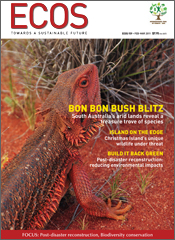
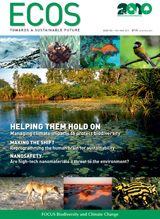
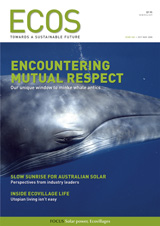
In this issue
 |
 |
ECOS
Issue 44
|
| |
|
|
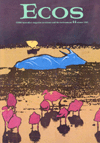
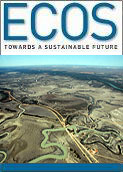
Buffalo in the Top End
Water buffalo are having a severe impact on the environment of northern Australia. Since its introduction to Australia, the Asian water buffalo has built up its numbers to about 250,000 and spread over a 100,000 square kilometre margin of coastal floodpl
Download Article
|
|
| |
|
Snaring the elusive trapped wave
Those studying nutrients, pollutants, and fisheries off Sydney should be aware that currents there are affected by oceanographic phenomena called coastal trapped waves that may be generated in Bass Strait or even in the Great Australian Bight. Over recent years oceanographers have come to place credence in the presence of these waves despite the lack of conclusive experimental evidence. Now a major experiment off the New South Wales coast has provided conclusive proof of their existence.



Download Article
|
|
| |
|
Pesticides: the nematode alternative
Worms, billions upon billions of tiny worms called nematodes, may soon be used as a biological control agent against many types of insects. Dr Robin Bedding of the Hobart Laboratory of the CSIRO Division of Entomology has been working with colleagues on ways of rearing them so that nematode sprays can be economically produced. He is now able to produce nematodes at a price that he believes will make these sprays a practical alternative to chemical sprays.
Download Article
|
|
| |
|
Weather in the sands
Day-to-day weather changes are taken for granted, but what about long-term differences in weather patterns? Meteorological records show variations from year to year, and these tend to obscure changes to climatic regimes occurring over decades and centuries. Furthermore, reliable records do not date back very far. How, then, can scientists read the weather over long time spans?
Download Article
|
|
| |
|
Small fry or big fish on the North-West Shelf?
Most of the continental shelf around Australia is narrow and already largely exploited by Australian fishermen. But off the north-west coast, the shelf is wide, the water is productive, and few Australians apart from prawn fishermen have attempted to establish a fishery there. At the moment a fleet of Taiwanese vessels is exploiting the area. Taiwanese gill-netters catch mid-water species such as shark, tuna, and Spanish mackerel, while the larger pair trawlers, mostly in the 350 tonnage class with a length of 30 to 40 metres, trawl for fish at or near the sea-bed. The fishery yielded an average of 53,500 tonnes annually for Taiwan between the years 1972 and 1978, the year preceding the declaration of the Australian Fishing Zone. This nearly matched the average fin fish catch, 59,500 tonnes, from all other Australian fisheries.
Download Article
|
|
| |
|
What comes out of a power station chimney?
Sphagnum moss grown in the clear air near Mt Kosciuszko has been used by CSIRO scientists to catch airborne material issuing from the Wallerawang power station in the Hunter Valley of New South Wales. Unlike other methods, such as those involving volume samplers, the moss system requires no power supply and virtually no maintenance. Continuous collection for long periods is assured.
Download Article
|
|
| |
|
Making sewage bugs work harder
A simple, but radical, modification to the operation of sewage treatment plants, developed by a CSIRO scientist, could significantly improve their efficiency. Municipal sewage is usually subjected to three levels of treatment. A primary treatment removes solids; a secondary one removes biochemical oxygen demand; and tertiary treatment removes nutrients (nitrogen and phosphorus). The Alternating Aerobic and Anaerobic (AAA) digestion process works as a secondary process but takes on a good deal of the tertiary as well.
Download Article
|
|
| |
|
Floating laboratory
Designed specifically for deep-ocean research around the Australian coast, Australia's most sophisticated research vessel, the Oceanographic Research Vessel 'Franklin' was launched in October, 1984 and, following fitting out and acceptance trials, has now begun work.
Download Article
|
|
| |
|
Pearls of wisdom
In order to hear, bony fish grow peculiarly shaped 'pearls', called otoliths, in their inner ears. Scientists are paying a good deal of attention to these otoliths since it was discovered that they grow in response to the fish's life rhythms. In addition, otolith growth appears to vary with the temperature of the water the fish inhabits, its feeding patterns, and important events in its life history.
Download Article
|
|
| |
|
| |
|
|