In this issue
 |
 |
ECOS
Issue 127
|
| |
|
|
The farmers' tree program that's growing potential
Research suggests that most farmers could plant trees and shrubs on up to 15% of their land helping farm health, agricultural productivity and income. A new three-way partnership will ensure that farmers, researchers, governments, conservation groups and industry work together to get the right trees in the right place.
Download Article
|
|
| |
|
Radioactive waste technology locking up interest
Construction is underway of a new plant that will transform liquid radioactive waste into a unique, synthetic rock product - known as `synroc' - developed in Australia. The technology is drawing international interest for its capacity to safely and permanently lock up nuclear waste.
Download Article
|
|
| |
|
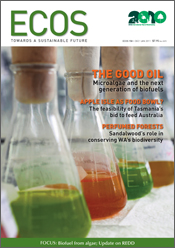
Going organic
Why is the organic food industry on the rise worldwide? Can it be both economically and environmentally viable, and feed the exploding world population, or is conventional broad scale agriculture, with its high farm inputs, the only way to meet the rising challenge? There are proponents of organic farming, passionate in their belief of its overwhelming advantages, but the approach also has its critics.
Download Article
|
|
| |
|
Growing China's great green wall
Chinese authorities are beginning the western phase of the historic and ambitious 'Great Green Wall', a 4,480-kilometre belt of forest across 551 counties and 13 provinces in north-west, central north and north-east China. Part of broader national environment programmes, it is the world's largest ecological development, and is designed to halt 2,460 square kilometres of land being lost annually to the expanding Gobi Desert due to overgrazing, deforestation and drought.
Download Article
|
|
| |
|
Natural services open for business
To help get the services provided to humans by the environment acknowledged, valued and protected, researchers have sought ways of 'commoditising' them. The recent emergence of fledgling trading markets in certain key 'ecosystem services' signals that this is being achieved. Steve Davidson reports on moves to establish such market mechanisms in Australia.


Download Article
|
|
| |
|
The Ecosystem Marketplace.com
Experts in financial markets, public policy, banking, forest ecology, economics, and forest industries, along with representatives from oil and energy companies and environmental groups, are behind the launch of an online marketplace for ecosystem services around the world. Buyers needing environmental credits and sellers of certain services can now find each other, negotiate deals and read the latest information on the burgeoning ecosystem services market.
Download Article
|
|
| |
|
How do locals value their habitat?
Most people appreciate that healthy, sustainable landscapes must balance the competing demands of agriculture, industry and the environment. But in planning for the future, some tough decisions have to be made about the best way to configure land, what to trade-off and who's to pay for it. Clare Peddie reports on work at CSIRO that sets out to survey how people value their local Australian habitat.
Download Article
|
|
| |
|
A voyage of discovery
Marine researchers recently spent four weeks on the Marine National Facility research vessel, Southern Surveyor, mapping the seabed and surveying biodiversity in previously unstudied areas along Australia's west coast. Their rewarding findings are increasing our understanding of the physical structure of the deep ocean seabed and the composition and evolution of its rich fauna. They also provide fundamental information for the development of national marine management plans that incorporate ecosystem-based principles.
Download Article
|
|
| |
|
Cooperation nets the benefits of bycatch reduction
Prawn fishers and scientists have spent the last 10 years investigating the best way to reduce the wasteful bycatch of undersize prawns and important non-target fish species during commercial prawn trawling on the north coast of New South Wales. A key aspect of the work was the development of special bycatch reduction devices.
Download Article
|
|
| |
|
Smarter chook shed design powers efficiencies
When Victorian chicken grower, Con Kyriazis, teamed up with civil engineer Stavros Rekaris to find a smarter chicken shed design, they made some basic changes using simple materials, and are now producing major energy savings, as well as happier chickens.
Download Article
|
|
| |
|
A red mud remedy
Following years of diligent research, scientists at Alcoa Western Australia have developed an effective way to deal with 'red mud', an undesirable bauxite residue generated in large quantities by alumina refineries.
Download Article
|
|
| |
|
| |
|
|