
In this issue
 |
 |
ECOS
Issue 57
|
| |
|
|
Tracking down the cause of a mysterious illness
While some manganese is necessary as a trace element in our food, with higher intake the element can become an insidious neurotoxin that only shows its debilitating effects years or even decades later. On Groote Eylandt most of the local Aboriginal population live on top of a high-grade manganese deposit.
Download Article
|
|
| |
|
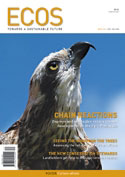
Where wedgies dare
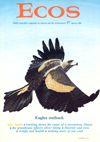
Popular as national symbols throughout history, eagles are indeed majestic birds, soaring effortlessly on rising currents of warm air. They are also, of course, strong and rapacious carnivores, preying on a range of creatures and scavenging carcasses (perhaps another reason why various States identify with them). Of 34 eagle species in the world, we have but three in Australia: the white-breasted sea-eagle, living near the coast or large bodies of water; the little eagle, which has a wide distribution but is not common; and finally, the largest of the three and the king of the inland sky, the magnificent wedge-tailed eagle.

Download Article
|
|
| |
|
Greenhouse effect: not all bad?
We hear a lot these days about the 'greenhouse effect' - the likely changes in the weather caused by the atmospheric build-up of gases, especially carbon dioxide, as a result of human activity. However, not much is known about the 'plant-fertilising effect', a possible silver lining inside that climate-changing greenhouse cloud.
Download Article
|
|
| |
|
Blooms and gloom
Tiny marine plants, called dinoflagellates, can make bodies of water appear red, brown, or luminous by night, and can cause oysters to be poisonous.
Download Article
|
|
| |
|
Fluoride and trees
Aluminium is a much used metal, but it cannot be just dug out of the ground. Usually it is mined in the form of aluminium hydroxide (alumina). A smelter heats the alumina until it is molten, mixes it with molten cryolite - a fluoride salt - and then performs electrolysis to yield elemental aluminium. When the International Aluminium Consortium of Western Australia proposed a smelter for Kemerton, WA, they commissioned a study to check on the environmental effects, as scientists in other locations had reported damaging effects on the plant life around smelters.
Download Article
|
|
| |
|
Weighing up your health
It is now well established that being too fat is bad for your health. Over-eating and excessive weight are implicated in many medical disorders common in affluent nations, such as heart disease, high blood pressure, diabetes, and gall bladder disease. Indeed, the nation's dietary excess is a serious public health problem.
Download Article
|
|
| |
|
Coal: clean, cleaner, cleanest
Coal has a dirty reputation - dirty to look at, dirty to handle, and dirty to burn. Two researchers at the CSIRO Division of Coal Technology want to change something of that. They envisage the Australian coal industry finding new export markets by offering 'superclean' and 'ultraclean' coal.
Download Article
|
|
| |
|
Fish on file
CSIRO has built up an impressive fish collection which will help us to understand and use wisely the biological resources of our oceans.
Download Article
|
|
| |
|
| |
|
|